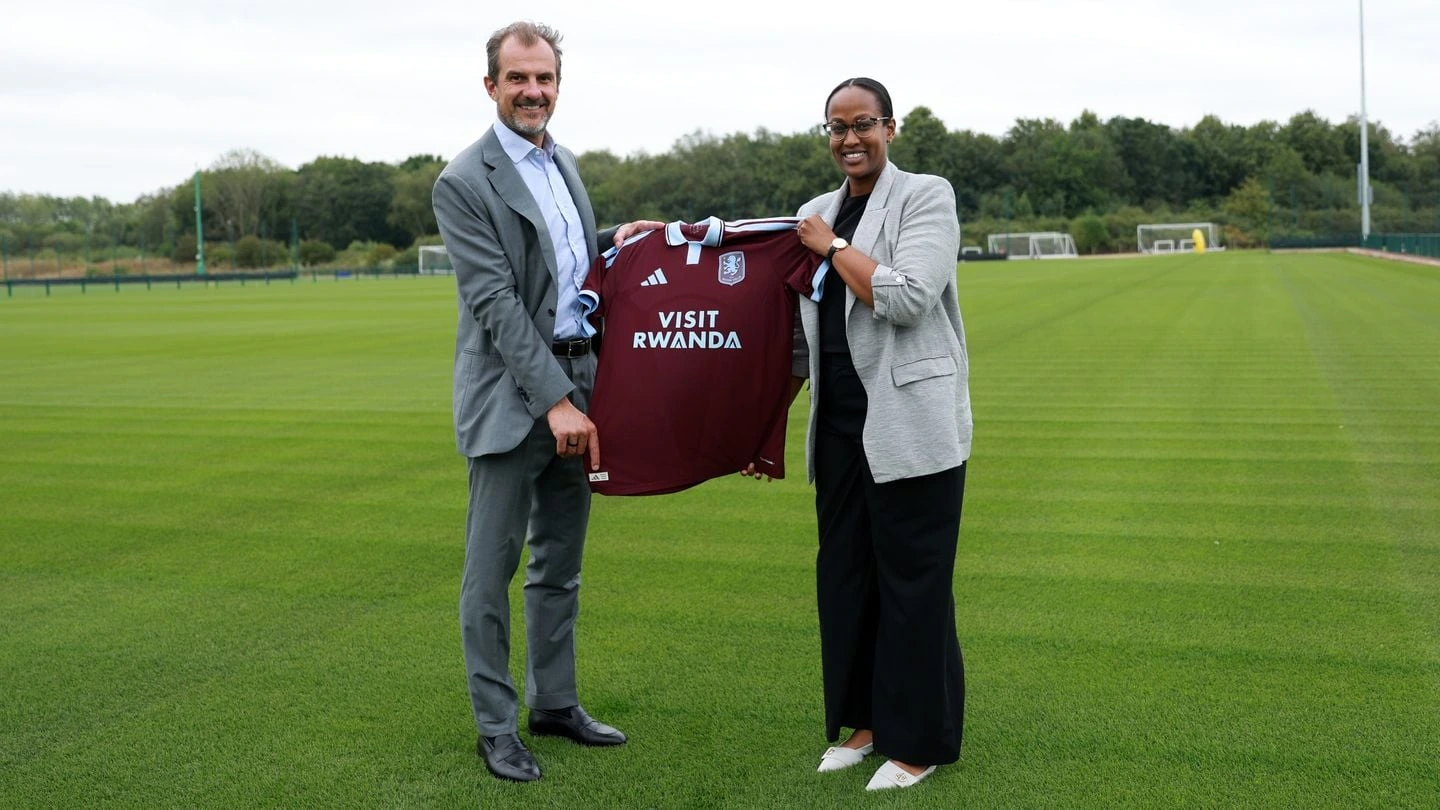
Aston Villa FC has signed a multi-year partnership with Visit Rwanda, placing the tourism brand on the front of the club’s shirts from the 2026/27 season. Announced on July 14, 2026, the agreement covers Aston Villa’s men’s, women’s and academy teams across domestic and European competitions.
The move keeps Rwanda visible in the Premier League immediately after its eight-season relationship with Arsenal ended. However, it is not a direct replacement of one identical contract with another: Visit Rwanda occupied Arsenal’s sleeve, while the Aston Villa agreement gives the brand the more prominent front-of-shirt position.
What the Aston Villa FC Sponsorship Includes
Visit Rwanda becomes Aston Villa’s principal shirt partner, exclusive tourism partner and official coffee provider under the new agreement.
The partnership includes:
- Visit Rwanda branding on men’s, women’s and youth-team shirts;
- commercial visibility at Villa Park;
- international advertising and digital campaigns;
- tourism, business and investment promotions;
- fan-focused experiences connected to Rwanda;
- football development and coaching programmes;
- academy exchanges and leadership initiatives;
- scholarships and professional development opportunities for Rwandans.
The coffee-provider element also connects the sponsorship to Rwanda’s export ambitions. Coffee is one of the products the country can promote through hospitality, matchday activity and international campaigns rather than treating the deal solely as tourism advertising.
Neither Aston Villa nor Visit Rwanda publicly disclosed the contract value. Media reports have estimated the agreement at approximately £20 million per year, but that figure should be treated as reported rather than officially confirmed.
Visit Rwanda Has Not Simply “Replaced Arsenal”
The change is better described as a shift in Rwanda’s Premier League sponsorship strategy.
Visit Rwanda became Arsenal’s first official sleeve partner in 2018. The branding remained on Arsenal shirts for eight seasons before the club and the Rwanda Development Board agreed to conclude the partnership in June 2026.
Arsenal subsequently signed global payroll and HR company Deel as its sleeve sponsor for the 2026/27 season. Visit Rwanda, meanwhile, moved to Aston Villa in a larger visual position across the front of the shirt.
| Partnership | Branding position | Period |
| Arsenal and Visit Rwanda | Shirt sleeve | 2018 to June 2026 |
| Aston Villa FC and Visit Rwanda | Front of shirt | From 2026/27 |
| Arsenal and Deel | Shirt sleeve | From 2026/27 |
This distinction matters because front-of-shirt sponsorship normally provides greater television exposure and stronger brand recognition than a sleeve placement. The Aston Villa deal therefore represents a change in scale and presentation, rather than the simple continuation of the Arsenal contract under another club.
Why Aston Villa Needed a New Principal Partner
Aston Villa previously carried the Betano name on its men’s shirts under a two-season agreement beginning in 2024/25. The club needed a new principal partner as Premier League teams prepared to remove gambling companies from the front of matchday shirts from the 2026/27 season.
Visit Rwanda gives Aston Villa a non-betting sponsor with an international tourism, trade and investment message. The agreement also extends beyond the men’s first team, giving the sponsor visibility through Aston Villa Women and the academy.
For the club, the partnership supports a wider commercial push into international markets. Aston Villa has expanded its profile through European competition, global sponsorships and development around Villa Park. A prominent international shirt deal provides revenue while increasing the club’s visibility in Africa and other markets targeted by Rwanda’s campaigns.
The unusual combination of tourism, coffee, investment promotion and football development also gives Aston Villa more activation options than a conventional logo-only sponsorship.
Why Rwanda Continues to Invest in Football Marketing
Rwanda uses elite sport to reach audiences that conventional tourism campaigns may struggle to access at the same scale. A Premier League shirt is shown during live broadcasts, highlights, social media posts, interviews and merchandise sales throughout the season.
The country’s strategy extends beyond attracting holidaymakers. Visit Rwanda campaigns also promote:
- conferences and business events in Kigali;
- foreign investment;
- conservation-focused tourism;
- Rwandan exports;
- international sporting events;
- the country’s image as a business destination.
Rwanda reported 1.49 million visitors and approximately US$685 million in tourism and conference revenue in 2025. Those figures do not prove that football sponsorship alone produced the growth, since visitor numbers are influenced by aviation, pricing, events, economic conditions and wider marketing. They do explain why Rwanda continues to regard international sport as an important channel.
The Aston Villa FC deal also complements Visit Rwanda partnerships with Paris Saint-Germain, Atlético Madrid, the Basketball Africa League and professional sports organisations in the United States.
The Political Dispute Around the Deal
The new sponsorship has renewed criticism of Rwanda’s use of European football to build its international image.
Amnesty International UK described the Aston Villa agreement as a potential example of sportswashing. Critics have linked the debate to human-rights concerns and allegations that Rwanda supports the M23 rebel group operating in the eastern Democratic Republic of Congo.
The Rwandan government denies supporting rebel groups in Congo.
The Democratic Republic of Congo previously called on Arsenal, Bayern Munich and Paris Saint-Germain to end their Visit Rwanda relationships. Sections of Arsenal’s support also protested against the former sleeve agreement, while Bayern Munich later restructured its partnership away from a conventional tourism sponsorship and toward a football-development programme.
These disputes do not change the commercial terms announced by Aston Villa, but they ensure that the sponsor will be examined as a political and reputational issue as well as a source of club revenue.
Aston Villa will therefore face questions about due diligence, the club’s commercial standards and how it responds to future developments in the region.
What the Partnership Means for Rwandan Football
The agreement promises more than shirt exposure. Visit Rwanda and Aston Villa have outlined cooperation involving coach education, academy exchanges, leadership programmes, charitable activity and opportunities for developing talent.
The practical value will depend on implementation. Training sessions and promotional visits can generate attention, but longer programmes with clear participant selection, qualified coaches and measurable outcomes are more likely to leave a lasting impact.
Key details still to watch include:
- which organisations in Rwanda will deliver the football programmes;
- how coaches and young players will be selected;
- whether scholarships cover football, education or professional training;
- how long individual projects will run;
- what results Aston Villa and Visit Rwanda will publish.
Those details will help distinguish sustained development work from short-term sponsorship activations.
What Comes Next for Aston Villa and Visit Rwanda
Visit Rwanda branding will become one of the most visible elements of Aston Villa’s 2026/27 identity. The sponsor will appear across the club’s teams while joint campaigns promote tourism, investment, coffee exports and football initiatives.
Commercially, the agreement gives Rwanda a larger shirt position than it held at Arsenal and allows Aston Villa to replace a betting sponsor with a multi-sector international partner.
The unresolved issue is reputational. The deal may deliver substantial global exposure, but every campaign will operate alongside scrutiny of Rwanda’s human-rights record and the conflict in eastern Congo.
The partnership should therefore be judged on two tracks: the commercial value it creates for Aston Villa FC and the transparent, measurable results it produces in tourism promotion and football development.